We returned from Goa on Tuesday after a wonderful Canadian Thanksgiving weekend on the beach. Back in Hyderabad, the heat was waiting for us, along with the usual assortment of activities that seem to fill our weeks here.
While we were away, Vishal had successfully kept Leo and Harriet alive, with Momi stopping by daily to make sure Harriet received her medication. Jack had also managed to injure his little toe at the construction site without mentioning it to anyone. Given his unusually high pain threshold, we didn't discover it until Tuesday. We cleaned it up, and thankfully it's healing nicely.
Ganesh had a promise to keep, too. Before Goa, he'd told Jack that good behaviour on the trip would earn him a visit to Burger King. Jack delivered, and this week Ganesh made good on the deal. I suspect he's learning that promises involving fast food are legally binding in our household.
With school closed for the Dussehra holidays, Gen and Vishal have been keeping Jack busy. Wednesday was the car museum, Thursday was lunch at Naani's and window-shopping at Decathlon, and Friday featured a scavenger hunt. But the real success story has been badminton. Vishal has been teaching Jack, and they now practise for about an hour every day. Afterward, Jack joins the other children in our apartment complex for another couple of hours of play. He's getting pretty good at it, and it's been wonderful seeing him accepted by the other kids and participating on equal footing. For Jack, that's a pretty big deal.
The swimming pool has also been getting plenty of use. Hyderabad remains stubbornly hot, and between swimming lessons and badminton, Jack is getting more exercise than most of us. Gen and I also joined the expats for some pickleball, and later in the weekend we played squash together for the first time in years. We've both been taking lessons since arriving in Hyderabad, so this seemed like an excellent opportunity to test our progress. It turns out that playing squash with your spouse requires a certain amount of diplomacy. I kept my game a little lighter, Gen tried out some of her newly acquired skills, and we both emerged from the court still speaking to each other. Apparently, that's enough of a success that we're planning to play again.
Gen also took Leo to the dog park and stopped at Café Eclat for bread and pesto. She's been taking advantage of India's wonderfully inexpensive books, too. Her latest purchases include Theo of Golden, Mother Mary Comes to Me and the first volume of Dragon Ball Z. At around ₹599 for many bestsellers, her reading habit is considerably more affordable here than it was in Canada.
For the past few weeks, an art exhibition called Show Keen had been popping up on my social media feeds. Eventually, curiosity got the better of me, and I clicked the link. It looked like a fantastic exhibition at HITEX, Hyderabad's enormous convention centre, and exactly the sort of thing we should be exploring during our year in India.
I tried registering us for Saturday, but the website was being particularly uncooperative. After several failed attempts, I handed the assignment over to Gen. Not only did she manage to register us, she somehow secured an invitation to Friday night's preview. I had been trying to get two tickets for Saturday. Gen had apparently got us onto the VIP list. Vishal arranged to look after Jack, and off we went.
We arrived and immediately realized we'd underestimated the dress code. Apparently, this was where Hyderabad's other half spent its Friday evenings. Gen was wearing a kurta and pants, and I was in jeans and a button-down shirt. Perfectly respectable outfits, but perhaps a little understated for an evening surrounded by Hyderabad's art-buying elite. We exchanged a look and silently agreed to adopt the persona of fabulously wealthy Canadians who simply didn't feel the need to dress the part. Old money. Understated. Possibly eccentric.
The exhibition itself was fantastic. The convention centre had been transformed into a labyrinth of temporary gallery walls, beautifully lit displays and intimate exhibition spaces. It felt more like wandering through a museum than a convention centre. The artwork was incredibly varied. Dark, moody paintings sat alongside colourful abstracts, surreal scenes, religious imagery and depictions of everyday Indian life. Most artists had five or six works on display, giving us a chance to appreciate their individual styles. I even recognized one sculptor's work from pieces we'd previously admired at the airport.
Each piece had a QR code with information about the artist, the artwork and, most importantly, the price. Naturally, we started scanning. Ten thousand Canadian dollars. Twenty-five thousand. Seventy-five thousand. And then something approaching $225,000. Suddenly, our outfits seemed entirely appropriate.
We also discovered an artist whose work we both loved: C. N. Karunakaran. His paintings were being offered through a private estate, and the curator explained that everything on display had already sold. His work was among the few pieces we saw that we might conceivably afford, provided we stopped eating for a month or two.
Gen and I have a tradition of buying a piece of art when we travel, and we're determined to bring something special home from India. We promised the curator we'd keep in touch. Perhaps we'll eventually own a Karunakaran, assuming the family is willing to embrace intermittent fasting.
There was also a spectacular jewellery section featuring elaborate wedding and formal pieces with enough diamonds and precious stones to require their own security detail. The watch displays were equally impressive, including some beautiful Cartier pieces. The people-watching was nearly as entertaining as the art.
About halfway through, we stumbled across something that immediately improved our opinion of the entire event. An open bar!
There were four cocktails displayed on the bar, so Gen and I made our selections, and I volunteered to get the drinks. This turned out to be considerably more complicated than anticipated.
The bar was absolute chaos. Imagine Hyderabad traffic, except everyone is standing still, nobody is using indicators, and the vehicles are shouting orders for gin and tonic. There was technically a queue, although it seemed to operate more as a loose suggestion. People behind me somehow ended up in front of me. Orders were being shouted from every direction, and the bartenders were desperately trying to keep up.
Gen surveyed the situation and offered some helpful tactical advice. "You need to be more Indian than Canadian." She then retreated to a safe distance, where she could observe the operation like a five-star general watching a military campaign unfold from the Situation Room.
I abandoned my Canadian instinct to wait patiently and began working my way toward the bar. Eventually, I reached the front, which I discovered offered absolutely no advantage whatsoever. The four cocktails on the menu had apparently become optional. People were ordering anything they could think of. "Gin and tonic!" "Scotch and soda!" "MORE SODA!" Orders were coming from every direction. The bartenders were taking instructions from people three rows deep, while I stood directly in front of them, apparently invisible.
And then it dawned on me. I had tried being Canadian. Gen had suggested being Indian. Perhaps it was time to be American.
I reached into my pocket, pulled out a ₹500 note, and discreetly slipped it into the bartender's hand. It was like parting the Red Sea. Suddenly, I existed.
The bartender stopped what he was doing, looked directly at me and asked what I wanted. Recognizing that this was a once-in-a-lifetime opportunity, I ordered four cocktails. All straight off the menu. No substitutions, no special instructions, and absolutely no chance I was coming back for another round. I returned to Gen carrying our drinks like a victorious hunter returning to the village. Five hundred rupees. Approximately eight Canadian dollars. Possibly the best investment I've made since arriving in India.
We found a high-top table, and Gen appeared with a small plate of cheese. Proper cheese is something of a rarity in Hyderabad, so this was an exciting development. Unfortunately, the cheese itself was thoroughly mediocre, although after the ordeal at the bar I would have happily eaten the plate it came on.
Sharing our table was an older couple, and we struck up a conversation. They were delightful, and it turned out the woman was Anita Bharat Shah, an author with a deep knowledge of Indian art. She showed us some of her books, and we had a fascinating conversation about Indian art and its evolution. By Sunday morning, Gen had ordered The Evolution of Indian Classical Art. She'd hoped to find it through a local bookstore, but eventually had to contribute to Jeff Bezos's retirement fund.
Then a younger woman appeared, gave Anita a big hug and joined our little gathering. Gen and I assumed this was our cue to move along, but the couple kindly introduced us. The younger woman looked at me for a moment. "Wait a second. Didn't I smile at you this morning at Botanika? Do you have a dog?" "Yes! And yes!" It was one of those lovely small-world moments. Hyderabad has more than ten million people, and somehow we'd managed to meet someone from our own apartment complex at an art exhibition across town.
We started chatting about art, and eventually the conversation turned to photography. I mentioned that I'd been taking street photography lessons while living in India, meeting my teacher at six every Sunday morning to explore different parts of Hyderabad.
"Oh, I love street photography!" she said. "That sounds amazing. Could I join you sometime?"
"Of course!" I replied.
"Great! Can I have your number?"
"Sure!"
And somewhere between reaching for my phone and exchanging numbers, a small alarm began sounding in the back of my head. Hang on a second. I'm standing at a fancy art exhibition, several cocktails into the evening, exchanging phone numbers with a young woman I've just met, while my wife stands approximately three feet away. This is going to be difficult to explain.
Unfortunately, by this point, I'd already committed to the transaction. There seemed to be no graceful way to suddenly announce that I didn't actually have a phone, or that I was morally opposed to WhatsApp. So I carried on, smiling politely, exchanging numbers and becoming increasingly aware that I was digging myself a rather impressive hole.
We eventually said our goodbyes, and as Gen and I walked away, I decided to acknowledge the obvious.
"Ummm, Gen. I think I just gave my phone number to another woman. Right in front of you."
"Ummm, yes. Yes, you did."
A pause.
"You must be quite proud of yourself."
And she started laughing.
The trouble was, I'd realized what was happening halfway through exchanging numbers. I could practically hear Gen composing her commentary while I was still holding my phone. But I'd committed, and apparently my solution was to keep going and hope for the best. But what was I supposed to do? Suddenly pretend I didn't have a phone? Tell her my wife handles all my bookings?
Gen wasn't remotely bothered. After 27 years of marriage, she's quite comfortable with the idea that anyone expressing an interest in me is welcome to discover exactly what they're getting themselves into. She didn't need to say any of that, of course. The look on her face was doing a perfectly good job. I'm beginning to suspect she'd have happily handed over my number herself.
We eventually found ourselves chatting with two women working for the exhibition organizers, and they were terrific. They told us all about Art Mumbai, insisting it was an absolute must. They compared it to Art Basel in Miami, although with a distinctly Indian focus rather than the global mix of artists you'd find there. Given how much we'd enjoyed Show Keen, we're now seriously considering making the trip.
By this point, we'd also discovered a new strategic location in the exhibition hall: a high-top table positioned directly along the route between the kitchen and the guests. I christened it the Strait of Hormuz. Every appetizer leaving the kitchen had to pass through our territory, and we were exercising our right to intercept as many shipments as possible. Gen and I had effectively established a naval blockade of the canapé supply chain.
Even better, the catering was being handled by Akina, our favourite restaurant in Hyderabad so far, and where I'd taken Gen for her birthday in August. Suddenly, the quality of the food made perfect sense. We were intercepting a steady stream of delicious little creations, including some fantastic lamb. The women explained that the lamb had been marinated in papaya to tenderize the meat. Who knew? We certainly weren't going to argue with the results.
Eventually, the cocktails needed replenishing, so I volunteered for another expedition to the bar. It was every bit as chaotic as before, but this time I was a seasoned professional. I marched straight into the crowd, abandoned the cocktail menu entirely and ordered four gin and tonics. Another ₹500 note found its way into the bartender's hand, and four minutes later I was back at our table with the drinks.
Like a boss.
The conversation with the organizers continued, eventually turning to jewellery and whether Gen should get her nose pierced. One of the women had a nose ring herself and told us the story of getting it, insisting she'd never regretted the decision. She was quite determined that Gen should do the same.
Gen hasn't ruled it out. After 27 years of marriage, I've learned that when Gen says she's considering something, there's a reasonable chance it's already halfway to happening.
By Sunday morning, I was back behind the camera. And before anyone asks, no, I did not bring my new girlfriend along.
My friend Sagar and I headed out at six in the morning to Maisigandi Maisamma Temple, about 50 kilometres outside Hyderabad, for what promised to be an interesting photography outing. Interesting turned out to be something of an understatement.
When we arrived, the place was practically deserted. Sagar assured me it would get busier as the morning progressed. He'd promised colourful market stalls, food vendors, religious ceremonies and plenty of opportunities for street photography. He wasn't wrong.
As the morning unfolded, the roads filled with cars, trucks, motorcycles and families arriving for blessings. But what really caught my attention was the extraordinary collection of vehicles parked facing the temple. Brand-new cars, decidedly less-new cars, farm equipment, ambulances and enormous tractor-trailers were all lined up waiting for their turn. Priests moved between them, blessing each vehicle with garlands, coconuts and bright bindi paint. Lemons were hung from front grilles and placed beneath tires as part of the rituals. It was quite a sight, particularly the enormous transport trucks decorated like they were attending a wedding. Apparently, in India, even an ambulance or a forty-tonne truck can benefit from a little divine intervention. Given what I've seen of Hyderabad traffic, I can certainly understand why.
And then there were the goats. And the chickens. And the sheep.
Tied to the backs of cars, trucks and motorcycles, animals waited patiently for what I was about to discover was a rather grim sequence of events. First came the blessing. A bindi on the forehead, a garland around the neck and a quick shot of local booze. Sagar explained that when the animal subsequently nodded its head, devotees interpreted this as a sign that it had accepted its fate.
Then came the knife.
The sacrifices were taking place openly, right around the temple grounds. Those performing them were remarkably welcoming, often inviting me to photograph the rituals and, in some cases, actively encouraging me to capture the results. Some held open the animals' freshly cut necks so I could photograph the blood. They were genuinely proud of what they were doing, and I was genuinely struggling to watch it.
As someone who loves animals, I found the whole experience pretty jarring. Some of the photographs I took will never see the light of day. Others will simply be deleted.
What fascinated me was how normal it all seemed to everyone else. Families were gathered together, children wandered about, and food vendors were busy preparing the freshly slaughtered animals. The meat was cooked right there, often as part of a family gathering. Whatever my reaction to the sacrifices themselves, there was something reassuring about seeing that the animals were being prepared as food.
Sagar explained that animal sacrifice isn't common across Hinduism, but it remains part of certain local and regional religious traditions. It's another reminder of how enormously varied religious practice can be across India.
There was also a rather entertaining subplot to our morning. Knowing we were travelling well outside the city and planning to photograph religious ceremonies, Sagar had done some advance planning. He'd contacted Arun, the temple director, and explained that he and his Canadian friend wanted to visit on Sunday to take photographs. Arun had been wonderfully accommodating. "Of course. Call me if you have any problems."
Sagar took this information and turned it into something approaching diplomatic immunity.
An official approached and suggested we needed to pay something. "Arun." Someone else wanted us to stand in a particular line. "Arun." Another person questioned where we were going. "Arun."
It was remarkable. One name, delivered with sufficient confidence, and suddenly the obstacles disappeared. I was travelling with a man who apparently had the equivalent of a backstage pass to Hinduism. Sagar understands India.
He also took me inside the temple for a blessing, which was an extraordinary experience. I'm starting to recognize the rituals now. You give your name to the priest for the blessing, remove your shoes before entering, never step on the threshold, and leave a few rupees for the priest afterward. And, importantly, you pay someone to look after your shoes. Otherwise, there's a reasonable chance you'll return from your spiritual experience to discover you've been blessed with a new requirement to buy footwear.
Standing before the deity, receiving the blessing and watching the rituals unfold was genuinely moving. I felt privileged to be there, particularly with Sagar guiding me through the experience. It was certainly an outing Thomas Cook is unlikely to include in its next Hyderabad itinerary.
I came away with some photographs I'm genuinely pleased with, particularly the quieter moments of devotion. An elderly woman making an offering at a small roadside shrine, a man in a bright orange turban holding a chicken, and families gathered around their vehicles for blessings. But I also came away with images in my head that will take a while to disappear.
When I got home, I remembered something I'd nearly forgotten. During my blessing, the priest had handed me two lemons with instructions to place them outside our front door to keep evil spirits away. So there are now two lemons sitting outside our apartment. I'm not entirely sure how long they're supposed to stay there, but I'm reluctant to throw them out and discover the hard way. And just to be clear, these lemons are strictly for spiritual protection. They're not for the G&Ts.
Friday evening had been spent admiring beautifully presented Indian art in an elegant gallery. Sunday morning was a much more visceral introduction to the traditions, beliefs and everyday realities that inspire so much of that art. Both experiences were fascinating. One was considerably harder to digest.
After a weekend like that, I've learned two important things about India. Always carry a few ₹500 notes, and if that doesn't work, find someone who knows Arun."
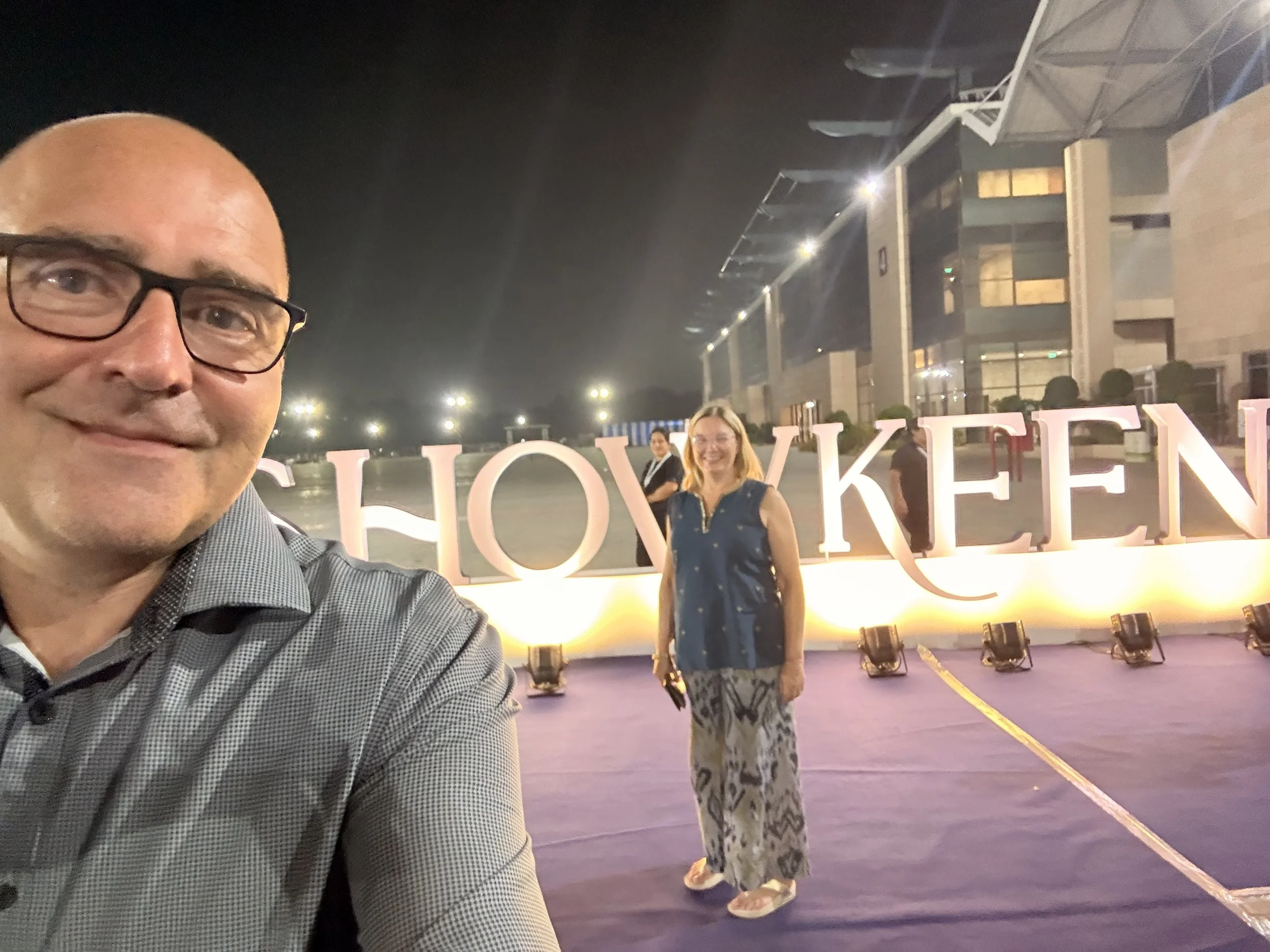
Highsociety Hyderabad Artshow…
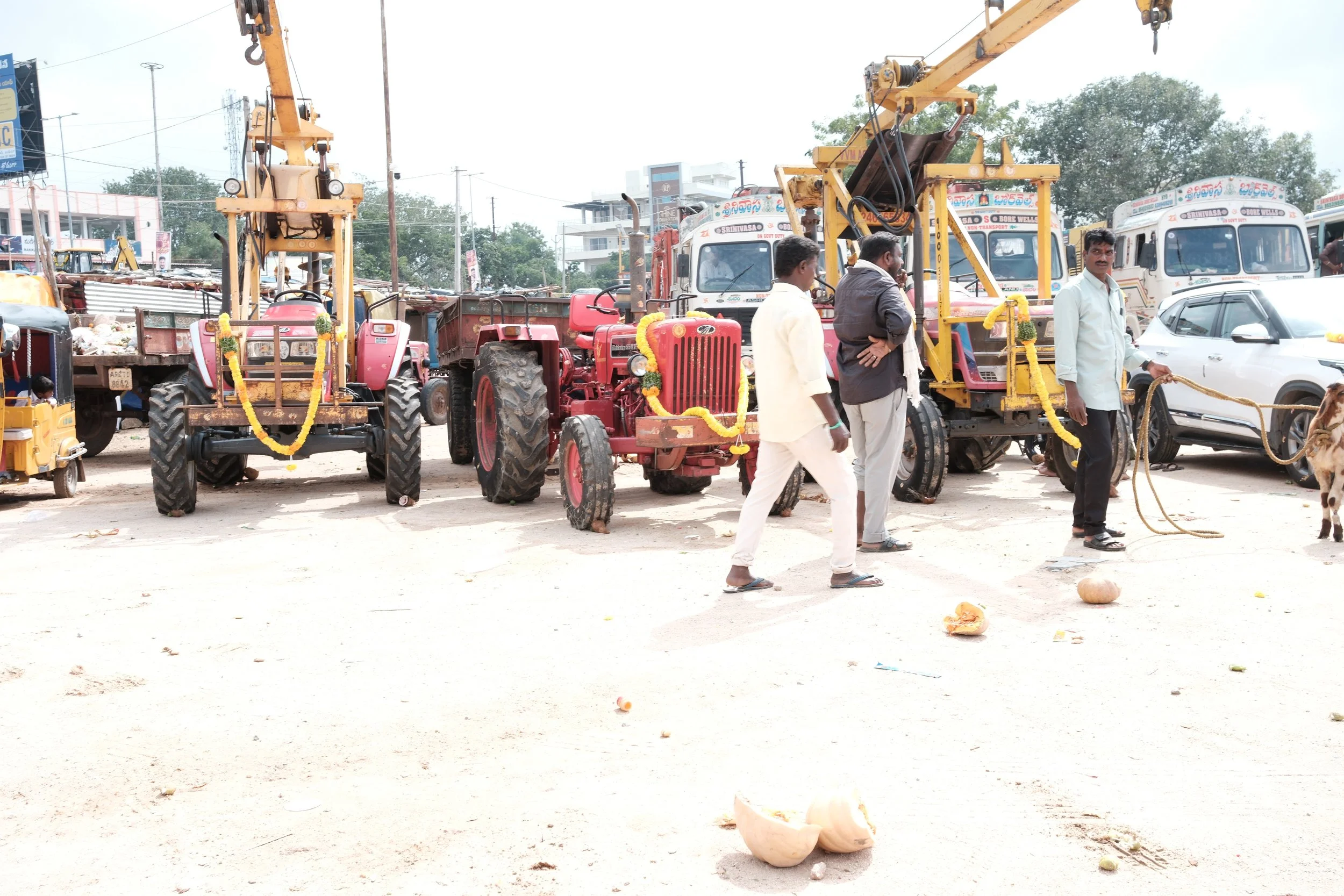
Farm Equipment Blessing at Temple…