Jack appeared at our apartment door on Sunday evening with a group of neighbourhood kids carrying approximately 20 pounds of fireworks. Their parents had apparently purchased them for the Diwali celebrations. In Canada, handing children that quantity of explosives would probably prompt a fairly serious discussion about parenting decisions. I decided some adult supervision was probably advisable.
Our apartment complex, had thoughtfully established designated fireworks areas and circulated a comprehensive twelve-point safety notice. Children were to be supervised, high-noise firecrackers discouraged, loose clothing avoided, long hair tied back, cotton preferred over synthetics, and everything finished by 10 p.m. Additional security personnel, fire extinguishers, buckets of water and first-aid kits would be available. All very reassuring indeed.
Jack had an absolute blast with his friends, although I watched him like a hawk. On several occasions he attempted to light a firecracker while still holding it, requiring some immediate intervention. Given the explosions around us, I wasn't particularly interested in testing the manufacturer's fuse specifications.
I quickly discovered that Indian fireworks appear to operate under different quality-control standards. My theory is that every firework that fails a safety inspection elsewhere in the world gets loaded onto a container ship and sent to India. There were bottle rockets, little things that exploded when thrown onto the ground, spinning contraptions shooting sparks everywhere, miniature flamethrowers and helicopter fireworks that launched into the air before flying off in whatever direction they pleased, occasionally towards nearby balconies. Whoops, I guess we're ignoring the twelve-point safety plan.
The real stars were enormous strings of firecrackers laid along the ground. Someone would light one end, retreat to what they presumably considered a safe distance, and the whole thing would begin exploding like a chain of extremely angry dominoes. Some went on for what seemed like two full minutes. These things had a serious blast radius.
We eventually went upstairs to prepare for the second part of our evening, a Diwali celebration at the home of Guruji, our 72-year-old yoga instructor. First, we gave Leo some gabapentin. The poor dog wasn’t appreciation the festivities as much as the rest of India, and we hoped it would help him settle.
Dressed in our traditional outfits, we decided to take a tuk-tuk rather than a car. Every street seemed to have its own fireworks display, with families gathered outside shops, children lighting crackers in alleys and enormous explosions coming from places we couldn't quite see. We arrived at Guruji's apartment to find his neighbourhood in full celebration.
Guruji and his wife, whom everyone calls Mataji, welcomed us incredibly warmly. Our Russian friend Irina and her American husband Will were also there. Guruji told us that in all his 72 years, this was his best Diwali because he was able to host us. He explained that in Hinduism, guests are treated like gods, and his family certainly took that responsibility seriously.
The only complication was that Guruji speaks Hindi and we don't. At yoga this isn't much of an issue, since most instructions involve demonstrating movements, shouting encouragement and occasionally laughing at our efforts. Dinner conversation required a different approach.
Guruji called his English-speaking son, who lives about two hours away, so I could speak with him by phone. Another woman from yoga had brought her son, who spoke excellent English and became our translator. I suspect his presence was thoughtfully arranged rather than coincidental. Between his help and some enthusiastic hand gestures, we managed to have a remarkably detailed conversation.
We started with salted apples, apparently good for digestion, followed by delicious spinach pakora, and began asking Guruji about his life. We see him several mornings a week but knew surprisingly little about the man beyond his flexibility, endless energy and enthusiasm for making us sweat.
Guruji joined the Indian Army in 1976 and served until 2000. Early assignments took him to northern India and the Chinese border, where he conducted training exercises on Himalayan glaciers in temperatures as low as minus 30 degrees. He trained soldiers on weapons systems, including Russian and Norwegian guns and mortars. He eventually transferred to Hyderabad in the 1990s and liked the city enough to stay. Despite living here for more than three decades, he proudly announced that he speaks absolutely ZERO Telugu, the local language. He seemed delighted with this achievement. Suddenly I felt considerably better about my own linguistic progress.
Throughout our conversation, the neighbourhood outside continued exploding. Some blasts were powerful enough to shake the apartment and send shock waves through our bodies. We'd be halfway through a question about his military career when BOOM, everyone would stop, wait for the windows to finish rattling and ask the translator to repeat the last three sentences.
Our translator explained that some of the enormous firecrackers were essentially rolls packed with gunpowder, designed for no purpose other than making an immense amount of noise. They produced explosions so powerful that I couldn't imagine anyone escaping serious injury if one went off in their hand. I suspect counting to five on one hand might be a thing of the past for anyone unfortunate enough to be holding one when it went off.
After leaving the army, Guruji opened a clothing business, eventually expanding to four stores. His sons entered the industry as well, and he helped establish their businesses. COVID forced him to close three stores, but at 72 he's still running the remaining shop and planning to expand again. Apparently retirement is not something he's particularly interested in.
The most remarkable part of his story, though, was how his yoga community began.
For years, Mataji had suffered from health problems that doctors had been unable to properly resolve. According to Guruji, they eventually reached the point where doctors told them there was little more they could do. Desperate to help her, he saw a television program about Hanuman yoga, began teaching himself the movements through YouTube videos and started taking Mataji to the botanical gardens each morning at 6:30 am to practise, 7-days a week.
That was in 2022. Initially it was just the two of them. Then a gentleman who had reportedly been bedridden for three years with a serious spinal problem asked to join. Over time, Guruji says, both Mataji and the gentleman experienced significant improvements. Word spread, others joined, and today between 30 and 50 people gather in the park every morning.
Guruji has never charged anyone a rupee. His only request is that they pay him in sweat.
He believes the group's success comes from being free, but I think there's more to it. People come for the exercise, but also the friendships, laughter and sense of belonging. He's created a genuine community from what began as a husband's loving effort to help his wife. Mataji is doing well today, and the gentleman who first joined them still attends every morning.
Eventually dinner was served, with homemade roti, chapati, rice, palak paneer, spicy pepper fry and several other dishes. Gen sampled some sort of curd preparation before I did. Her expression provided enough information for me to make an informed decision to pass.
The hospitality was relentless, in the nicest possible way. Every time we finished something, another helping appeared. Saying no seemed to be interpreted as a request for something different. More rice? Another chapati? More paneer? There was clearly no intention of letting us leave hungry. After serving us, Guruji and the family eventually settled on the floor to enjoy their own meal while we returned to the sofa.
After about two and a half hours, we were ready to head home. Jack had done remarkably well, particularly given the extraordinary sensory intensity of the evening. I was getting close to feeling overstimulated myself.
The tuk-tuk ride home was something else. The entire city was enveloped in a thick haze from thousands upon thousands of fireworks. An acrid, phosphorus-like smell hung everywhere, catching in the back of your throat. The smoke softened the streetlights and made the air unpleasant to breathe. People were talking about the Air Quality Index approaching dangerous levels, and it wasn't difficult to believe.
At one point, we passed someone setting off a long string of firecrackers. We were probably 40 feet away when a piece of burning debris flew through the open side of our moving tuk-tuk and hit me directly in the face. Fortunately, no injury, but it certainly reinforced my appreciation for the blast radius.
Back at Botanika, I stood on our balcony looking over Hyderabad. Fireworks were exploding in every direction, rockets shooting between buildings, enormous flashes illuminating the haze and continuous booming echoing across the city. Distant buildings were barely visible through the smoke. It reminded me of television images of a city under siege. Shock and awe was the phrase that came to mind.
This was a city celebrating one of its most important festivals, and people were having the time of their lives. It was just a very different fireworks experience from the carefully choreographed displays we're accustomed to in Canada.
We eventually went to bed, but the explosions continued long past midnight. So much for Botanika's 10 p.m. cutoff. Fortunately, I was still jet-lagged from Canada and could probably have slept through anything.
Tuesday was another busy day, particularly for Gen, who headed out on her weekly walk and talk with her friends. This week's outing was a little more spiritual than usual, with visits to two temples outside Hyderabad.
Their first stop was the Kolkata Kali Mata Temple, situated in a pleasant rural setting beside a small lake. One of the more unusual things Gen noticed was a large balance scale where a person could sit on one side while their offering was weighed on the other. It's a form of religious offering known as tulabhara, something neither of us had encountered before.
One of the stranger sights was what appeared to be the ghostly remains of a goddess idol beside the lake. It was still draped in what looked like a sari, but most of its face and body had disappeared, leaving an eerie straw framework behind. We suspect it had been immersed in the lake during the Diwali celebrations. These enormous idols are traditionally constructed from bamboo, straw and clay, and after immersion the clay can wash away, leaving the internal structure and clothing behind. It was a rather haunting sight, particularly as we couldn't tell which goddess it had once represented. Not quite what Gen had expected to encounter on her morning walk.
Workers were still dismantling enormous scaffolding structures from the Diwali celebrations, and there was plenty of cleanup underway. Gen enjoyed the country setting but was struck by the amount of garbage in the lake, where people also appeared to bathe and wash their clothes. It's a contrast we keep encountering in India, beautiful temples and religious sites surrounded by areas that receive considerably less attention.
Their next stop was the Statue of Equality, a relatively new temple complex built on an absolutely enormous scale. The centrepiece is a towering golden statue of the eleventh-century philosopher and spiritual leader Ramanujacharya. Gen was impressed by the sheer size of the place and the beauty of the buildings, both inside and out.
While walking around, she noticed signs advertising an attempt to establish a Guinness World Record. Better yet, it was happening that very day.
The event was called Viswa Santhi Virat Parayanam, a mass recitation of the Sri Vishnu Sahasranamam, a sacred Hindu text containing a thousand names of Vishnu. Thousands of people would gather at the temple complex, while others could participate online, chanting together as a prayer for world peace. The event was part of celebrations marking the 70th birthday of Sri Chinna Jeeyar Swamiji, a prominent Hindu spiritual leader.
Naturally, Gen signed up.
That evening she logged in from our apartment and joined the virtual chanting for 14 minutes. And they did it! Guinness World Records confirmed the achievement, with reports indicating more than 10,000 people participated. An official certificate was presented to the organizers, and Gen is now waiting for her own participation certificate.
This will be a splendid addition to her growing collection of official achievements. You may recall that back in July she attended a pottery class, made a flower-shaped tea-light candle holder and received a Certificate of Awesomeness for her efforts. She'll soon be able to display that alongside her Guinness World Record participation certificate. Quite the collection she's building.
Meanwhile, Vishal and Jack had a rather different cultural experience on Tuesday. Vishal took Jack for a haircut, only to discover that the barber was closed.
Apparently, many Hindu families consider Tuesday an inauspicious day for cutting hair or nails. The day is associated with Hanuman and Mars, and some people avoid grooming out of respect for religious traditions or concerns about bad luck. Since fewer customers come in on Tuesdays, it's also become a practical day off for many barbers.
They returned on Wednesday, and Jack got his haircut for ₹180.
For comparison, the last time I took Jack for a haircut, it cost ₹2,800. That's a difference of ₹2,620, or roughly 94 percent. Apparently I got the executive haircut rate. Vishal will now be responsible for all future haircuts.
Wednesday was Remembrance Day, and I had the day off. Gen had also realized that if we wanted to get Christmas cards printed in India and mailed to friends and family in time for Christmas, we needed to get moving. We decided to surprise Jack and Vishal with an outing to Snow Kingdom at Sarath City Mall.
Yes, Hyderabad has a snow hill! On the fifth floor of our local shopping mall, someone has constructed an indoor winter attraction where the temperature is maintained at approximately minus eight degrees Celsius. Outside, it was 31 degrees. How could we possibly resist?
Gen and I had brought winter gloves, mitts and toques to India in case we eventually went skiing in Kashmir. We finally had an opportunity to use them. We arrived with our own sweaters, shoes and winter accessories, only to discover that they supplied jackets, rubber boots, hats and mitts anyway.
There was a toboggan hill with a slope slightly steeper than a Canadian driveway, some icy walls, a trampoline and manufactured snow scattered around the floor. They even had an ice-climbing wall, although none of us was particularly interested in testing its structural integrity. For that matter, I did wonder whether someone had done the engineering calculations for the weight of all that snow sitting on the fifth floor of a shopping mall.
It was every bit as ridiculous as we'd hoped.
And we had an absolutely fantastic time.
Jack immediately began racing around, sliding down the hill and trying the trampoline. We all went tubing, although the real entertainment was Vishal, who was experiencing snow for the first time. I decided he needed a proper Canadian introduction, which naturally involved throwing snowballs at him.
As he came sliding down the hill, I'd scoop up snow and launch it directly at his face. After one particularly well-aimed shot, he looked at me and said, "Sir, you're really a professional." Finally, after 54 years, recognition for my true athletic talent.
Vishal quickly caught on and began retaliating. Then Gen joined in and hit him squarely in the face. You could almost see the calculation taking place. Could he throw a snowball at Mam? Was that permitted? Would he still have a job? The answer was apparently a resounding no, and he wisely let that particular offence go unanswered.
At one point, we introduced him to another Canadian winter tradition: the face wash. For those non-Canadian’s unfamiliar with this particular childhood cruelty, it involves grabbing a handful of snow and rubbing it directly into your opponent's face. Vishal was completely shocked. He'd only just learned that snow could be thrown at people, and now he was discovering an entirely new range of offensive applications. The variety of ways Canadians have developed to attack one another with frozen water was apparently quite astonishing.
We were all in hysterics. Watching Vishal experience snow for the first time was wonderful, and what we'd expected to be a rather silly little outing turned into one of the funniest afternoons we've had in India.
The staff were somewhat less enthusiastic. Most looked rather grumpy, although I suppose I'd feel the same way if I were accustomed to Hyderabad's tropical climate and my job involved spending eight hours a day in a freezer.
We finished with some wonderfully cheesy Christmas photographs in front of a plastic house and reindeer. The only problem was that Alessia was in Canada. No problem. With a little help from AI, we simply inserted her into one of the photographs as though she'd been there all along. We then worked up a design with some Indian touches and had the cards produced at a local print shop. Our Canadian friends and family will soon receive a Christmas card featuring a family snow day in Hyderabad, including one family member who wasn't actually in the country. I wonder whether Alessia will remember the outing as fondly as the rest of us.
Friday morning, we flew to Mumbai. Gen and I had been looking forward to the trip, partly for Art Mumbai, one of India's major contemporary art fairs, but also because we'd heard so much about how cosmopolitan the city was. After enjoying the art exhibition at HITEX in Hyderabad a few weeks earlier, we thought this would be a great opportunity to immerse ourselves in art and explore a very different side of India.
Jack and Vishal came along, although both were battling colds. We sometimes feel a little guilty bringing Vishal on these trips because so much of his time is spent looking after Jack while we go off exploring. He gets to visit cities and places he's never been before, but doesn't necessarily get to see very much of them. He insists that he's having a wonderful time with Jack, and I believe him, but we still want him to have opportunities to explore and enjoy himself.
We arrived late in the morning and checked into the ITC Grand Central, a beautiful hotel in the heart of the city. Our first impression of Mumbai was that it felt remarkably different from Hyderabad. More international, more visibly wealthy, and with an energy that reminded us of New York, if someone had moved Manhattan to India and Indianized it.
The part of Hyderabad where we live was largely developed over the past thirty years. Huge areas were bulldozed and replaced with gleaming technology parks, office towers, apartment complexes and shopping malls, often with seemingly little regard for how the whole thing would function as a city. Roads, sidewalks and other basic infrastructure sometimes appear to have been afterthoughts.
Mumbai feels completely different. It's a city that has grown and evolved over centuries, with layer upon layer of history. Magnificent colonial-era buildings stand beside modern skyscrapers, which in turn overlook enormous slum communities. Beautiful old neighbourhoods sit alongside extraordinary wealth and poverty, sometimes separated by little more than a street. It's wild, fascinating and incredibly textured. You can feel the history of the place everywhere.
The other immediate difference was the traffic.
Mumbai has something like 22 million people compared with Hyderabad's 11 million, and it's incredibly dense. There is still plenty of traffic, plenty of honking and plenty of congestion, but people actually seem to follow some basic rules of the road. Drivers signal. They stop at traffic lights. There are more traffic lights to stop at. Cars don't weave quite so aggressively between lanes, and the police apparently take traffic enforcement more seriously.
And there are sidewalks! Actual sidewalks. Places where people can walk without having to negotiate motorcycles, parked cars, open drains and assorted obstacles. We were astonished. Mumbai may be twice the size of Hyderabad, but in some respects it feels considerably more civilized.
Another noticeable difference is the animals. Hyderabad seems to be full of stray dogs, but you rarely see cats wandering around. Mumbai, on the other hand, has cats everywhere! They lounge on walls, wander through lanes and seem perfectly comfortable making themselves at home wherever they please. Gen is absolutely delighted. Not about the fact that they're strays, of course, but simply because there are cats. She's been suffering from a serious shortage of feline encounters since we arrived in India, and Mumbai has finally addressed the problem.
After settling in, Gen and I headed to the Mahalaxmi Racecourse for Art Mumbai. We'd purchased VIP tickets, figuring that early access and a few extra privileges might make the experience more enjoyable. Upon arrival, we were handed complimentary glasses of wine, which seemed like an excellent start.
And then we saw the crowd.
We thought we'd encountered wealthy people at the art show in Hyderabad. Apparently those were the junior leagues. Mumbai's rich and famous were out in force, beautifully dressed and moving through the exhibition halls with the sort of confidence that comes from being able to buy a painting without checking your bank balance first.
The art was extraordinary. Gallery after gallery featured paintings, sculpture, photography, installations and mixed-media works from across India and beyond. Some of the paintings we'd admired in Hyderabad had price tags approaching $200,000. Here, half a million dollars didn't seem particularly unusual. We were very much in the looking category rather than the buying category.
Gen particularly loved a series of marigold paintings by Olivia Fraser, a British artist who moved to India in 1989 and studied traditional Indian miniature painting techniques. Before coming to India, marigolds weren't flowers we'd given much thought to. Now their brilliant orange and yellow colours are everywhere, strung into garlands, decorating temples, hanging from doorways and appearing at virtually every festival. They've become one of the colours we associate most strongly with India, and Fraser's work captured that beautifully.
We also admired works by Bhuri Bai and N. S. Harsha, some striking striped paper collages by Yuvan Bothysathuvar and a fascinating grid of moth etchings by Tanujaa Rane. There were hundreds of other pieces we loved, many by artists whose names we didn't manage to record. It was a wonderful opportunity to see the breadth of contemporary Indian art, from traditional influences to very modern interpretations.
Unfortunately, I was also mildly distracted by work. Microsoft was experiencing a significant global cloud outage, and my phone kept lighting up with calls and messages. I did my best to pay attention to the art but checking what was happening back at the bank was the priority. Not quite the uninterrupted cultural experience I'd planned. But that’s life.
During a break outside one of the exhibition halls, a friendly gentleman invited us to sit beside him. We discovered he was an art lawyer from Kolkata, which is apparently an entire profession I hadn't previously considered. His work involves due diligence, verifying authenticity, checking ownership and making sure the extremely expensive object someone is purchasing is actually what they think it is.
I asked whether he ever offered clients his personal opinion about the art they were buying. He laughed.
"Absolutely not. All I care about is whether they pay me."
A refreshingly practical approach to the appreciation of fine art.
He was fascinating to talk to and insisted that when we eventually visit Kolkata, we'll love it even more than Mumbai. He even offered to take us for lunch. Given how much we were enjoying Mumbai, that seemed like a fairly bold prediction.
That evening, I'd arranged a surprise dinner for Gen at Masque, one of Mumbai's most celebrated restaurants. Our Uber took us through a series of increasingly narrow streets and alleyways, to the point where we began wondering whether the driver had misunderstood the destination. Eventually we arrived at an unassuming entrance, stepped inside and found ourselves in a gorgeous restaurant.
We settled in for an elaborate tasting menu paired with Indian wines. I'll admit we were initially a little skeptical about the wine pairings, but it turns out we had a great deal to learn.
The pairings included limited-production wines, private collections and wines from Indian vineyards with connections to renowned European winemakers. Some were produced in tiny quantities and weren't the sort of bottles you'd expect to find on a supermarket shelf. The sommelier explained the wines and their relationship to each course, and they were genuinely excellent.
The food was a gastronomic adventure. One course was a delicate puri that exploded in your mouth, releasing an extraordinary burst of flavour. Another was Bombay duck, which despite its name is actually a fish, transformed into a crisp cracker and served with fish broth and roe. There was a brilliant interpretation of a duck taco and a drink made with salted-milk soda, served in what appeared to be an entire bouquet of parsley.
Every course was inventive, beautifully presented and full of unexpected combinations of Indian ingredients. Reading the menu afterwards barely did the experience justice. It was one of those meals where you occasionally had to stop and ask yourself what exactly you'd just eaten, followed almost immediately by the realization that it was delicious.
We asked our waiter about the Michelin Guide, which has yet to establish a restaurant guide for India. He told us that they believe Michelin may finally be coming to India next year and that Masque is very much hoping to earn a star. Based on our evening, I wouldn't be surprised if they did. The whole experience was exceptional, from the creativity of the food to the service and wine pairings. We'll certainly be watching to see what happens.
After dinner, we returned to the ITC Grand Central, where Vishal headed off to check into his own hotel. He was feeling particularly miserable with his cold, so we gave him some Canadian cold medication we'd brought with us. He later reported that it was very good stuff.
Saturday morning, Vishal and I headed out for an early photography session in Khotachiwadi, a historic neighbourhood in Girgaon known for its narrow lanes and colourful Portuguese-influenced houses. I'd asked Vishal whether he'd be interested in joining me for a photography outing, something he'd expressed an interest in doing before. He was enthusiastic, and I was delighted to have him along. We'd originally planned to get there around five in the morning to catch the best light. That plan lasted until we woke up and discovered it was already seven.
Vishal now has his own camera, a Fuji-mount model in the same product series as mine that his brother bought for him. The two of them have an extraordinarily close relationship and support one another in ways that I find genuinely touching. It was an incredibly generous gift, and it was lovely to see Vishal using it.
Khotachiwadi is a remarkable pocket of old Mumbai, with wooden houses, colourful shutters, balconies and narrow lanes that seem completely removed from the enormous city surrounding them. It's a photographer's dream, except for one rather inconvenient detail. There are signs everywhere saying photography is prohibited.
Apparently some residents have taken it upon themselves to put up these signs, although I'd read that the police have challenged their authority to prohibit photography in public lanes and have sometimes removed the notices. Regardless, we were respectful, concentrating on the architecture and streets rather than photographing directly into people's homes.
Most residents didn't seem particularly bothered. One gentleman, however, emerged from his house and questioned why we were taking photographs. He was clearly unhappy about it and seemed rather determined to make his point. We didn't argue. We simply continued our walk, respecting people's privacy while enjoying the remarkable architecture.
Later that morning, Gen and I began a completely different adventure. We wanted to retrace the footsteps of her great-aunt Helen, known to the family as Nell, who had travelled to Bombay more than a century ago to work in medicine. We had old letters and family records, and Gen had been piecing together her remarkable history.
Nell's correspondence documents a series of journeys between Europe and India over many years. She travelled from Bombay towards Trieste aboard the SS Graz in early 1914, arrived in Bombay on the SS Arabia in March 1915, returned aboard the SS China in September 1925 after embarking at Marseille, and made other journeys on ships including the SS Pilsna and SS Genova. These weren't quick trips. They were lengthy sea voyages at a time when travelling between continents was a major undertaking.
We'd been looking at photographs of some of these ships, trying to imagine what it would have been like to arrive in Bombay aboard one of them, disembark into the heat and bustle of the harbour and begin another chapter of life in India.
Our first stop was Ballard Pier and what we thought was the old Customs House near the harbour. We wandered around trying to imagine where the ships would have docked and what the waterfront looked like in Nell's day. It was only later that we discovered we'd actually been standing outside the new Customs House, which is itself about 150 years old. In Mumbai, apparently, even the new buildings are older than Canada.
We were also running out of time because we'd booked a guided walking tour back at Art Mumbai. So we reluctantly abandoned our historical detective work and headed back to the racecourse.
Our second day at the fair was just as enjoyable as the first. We explored more galleries, discovered new pieces and continued enjoying the people-watching. The guided tour, unfortunately, was less impressive. We followed along for a while before deciding we were having more fun exploring on our own and quietly disappearing halfway through.
We also had an important piece of unfinished business. On Friday, the organizers had run out of the Art Mumbai tote bags that came with our VIP admission. Naturally, we made sure to collect them on Saturday. Two very nice tote bags, which I'm sure will prove extremely useful for carrying things we already own.
With our art fix satisfied, we resumed the family-history mission and headed for the Gateway of India.
The Gateway is one of Mumbai's most recognizable landmarks, an enormous ceremonial arch overlooking the Arabian Sea. It was built to commemorate the 1911 visit of King George V and Queen Mary, although it wasn't completed until 1924. It later became famous as the place where the last British troops ceremonially departed India in 1948.
The timing was particularly interesting given Nell's travels. The Gateway hadn't existed during her earlier voyages, but it would have been a prominent new addition to the waterfront when she returned to Bombay in 1925.
There were people everywhere. Thousands of them, or at least what felt like thousands, packed into the plaza, taking selfies, posing for photographs, buying snacks, watching boats and enjoying the spectacle. Families were dressed in beautiful clothes, children were running around, and everyone seemed determined to get the perfect photograph with the Gateway in the background.
Gen, meanwhile, had somehow become an attraction in her own right.
This has happened to her several times in India. It usually begins with a little girl, perhaps seven or eight years old, approaching shyly to ask about Gen's hair and where she's from. Then the photographs begin. At the Gateway, a number of Muslim women approached her asking if they could take pictures with her. Then more appeared. Gen would pose with one group, only to have another group come over. It was all very friendly and rather sweet, although I began wondering whether we should start charging admission.
We eventually escaped the crowds and made our way into the Taj Palace Hotel, which opened in 1903 and would already have been standing when Nell first arrived in Bombay. It's a magnificent building, full of grand staircases, elegant interiors and old-world atmosphere. The sort of place that makes you want to order a gin and tonic and pretend you own a shipping company.
But I couldn't walk through the Taj without thinking about the November 2008 terrorist attacks. The hotel was one of the principal targets during the coordinated attacks on Mumbai, which killed 166 people across the city. The images of the Taj burning, with guests and staff trapped inside, are still vivid in this countries memory. Standing there, in the very building we'd watched under siege on television, was a strange feeling. It's a beautiful hotel with a remarkable history, including a chapter that's impossible to forget.
We settled into the Harbour Bar for drinks and appetizers and began going through Nell's letters, using ChatGPT to help research the ships she had travelled on and what the city would have looked like during her visits. The Harbour Bar itself didn't open until 1933, but the hotel was already a prominent landmark when Nell was travelling through Bombay.
We were also curious about what it might have cost to stay at the Taj in those days compared with the missionary accommodation where Nell stayed.
The Taj's opening rates in 1903 were apparently ₹10 for a room, ₹13 with a fan and attached bathroom, and ₹20 for full board. Our rough calculations suggested that would be equivalent to something like C$90, C$120 and C$180 in today's purchasing power, respectively. Given that a room at the Taj today can run around C$750 a night, clearly the hotel has become considerably more expensive over the past 123 years.
Nell stayed at a place called Olive Missionary Lodge, which we haven't been able to locate. We couldn't find its actual rates, but a later example of institutional accommodation from 1935 charged ₹2 a day, roughly equivalent to C$18 in today's money. It gave us some sense of the difference between the world of wealthy travellers at the Taj and the much more modest accommodation Nell likely experienced.
Given some of Nell's comments about drinking in her letters, I'm quite certain she wouldn't have approved of our afternoon gin and tonics. Then again, the Harbour Bar wasn't there during most of her time in Bombay, so perhaps she was spared the temptation.
While we were there, Gen wandered into Gazdar, a historic jewellery shop inside the hotel, and spotted a beautiful ring. She'd been looking for something special for a while, and this was exactly what she'd had in mind. It has an elegant design resembling abstract leaves, and after looking at it together, we decided to buy it. An unplanned purchase, but a lovely souvenir of Mumbai.
We even wondered whether Nell might have visited the same shop all those years ago. There's no way of knowing, but it was a nice thought.
After leaving the Taj, we continued searching for places connected to Nell's time in Bombay. One of the most important was the building that now houses the Institute of Science.
During the First World War, the buildings housed the Freeman Thomas War Hospital, where Nell worked as a surgeon from November 1917 until July 1918. Suddenly, we had a very specific place to visit, rather than simply imagining her arrival at the harbour.
We found the building and went inside, standing in the foyer and looking around. The security guard spoke no English, and our attempts to explain why we were there and what we were looking for were met with a shrug. There were no signs describing the building's former use as a wartime hospital, and we couldn't identify which part of it might once have contained Nell's ward or operating theatre.
We'd found historical photographs of the hospital from around 1918 and tried to match them to the architecture in front of us. We walked around the exterior, studied the facade and compared the old images with what remained. The surrounding streetscape has changed enormously, but the building itself gave us something tangible to connect with her story.Nell had travelled halfway around the world at a time when the journey itself was an enormous undertaking, and here we were, more than a hundred years later, standing in the building where she'd worked as a surgeon during the First World War.
Meanwhile, Jack and Vishal were having an adventure of their own. Despite still feeling under the weather, Vishal took Jack to Mani Bhavan, the Gandhi Museum, where they explored the exhibits and learned about Gandhi's life and his connection to Mumbai. Their main report afterwards was that the museum was smaller than expected, so I'm not entirely sure how much time they spent studying the exhibits.
Afterwards they went for a walk along Marine Drive, the famous waterfront promenade overlooking the Arabian Sea. Jack even got to touch the ocean, although both he and Vishal were rather unimpressed by the amount of garbage in the water. They were also surprised to see people swimming in it.
Jack did incredibly well, and the two of them had a fantastic time. We were particularly pleased that Vishal was getting to see more of Mumbai himself, rather than spending the entire trip in the hotel.
They also managed to find a Subway for dinner, which Jack seems capable of locating in virtually any city on earth. This had the added advantage of avoiding the astronomical prices of the restaurants at the ITC Grand Central. We were extremely grateful for the thriftiness. Given what Gen and I had been spending on restaurants, someone in the family needed to exercise a little financial restraint
The hotel swimming pool was another popular destination for Jack and Vishal, and once again confirmed why having a pool has become a non-negotiable requirement whenever we travel with Jack.
When we returned to the ITC Grand Central on Saturday afternoon, we stumbled into what turned out to be one of the most unexpectedly entertaining events of the entire trip.
The hotel was hosting its annual Christmas cake-mixing ceremony, and the place was absolutely buzzing. Christmas music was playing, singers were performing "Deck the Halls," people were wandering around in Santa hats, and there was an enormous vat in the middle of the room filled with dried fruit, nuts and other ingredients destined to become Christmas cake. There was also some sort of strange mascot wandering around that looked vaguely like Boss Baby. I have absolutely no idea what he had to do with Christmas, cake or anything else, but he seemed to be enjoying himself.
For anyone unfamiliar with the tradition, Christmas cake mixing involves combining enormous quantities of dried fruit, nuts and spices with alcohol, then leaving the mixture to mature before it eventually becomes the hotel's Christmas cakes. It's a tradition at many of India's grand hotels, and apparently it's also an excellent excuse to throw a spectacular party.
Gen took one look at the enormous vat and announced, with tremendous enthusiasm, that she was going to mix the cake.
Before I knew what was happening, she'd disappeared in search of gloves so she could join the action. There she was, surrounded by hotel chefs, guests and celebrities, gleefully plunging her hands into an enormous vat of Christmas cake ingredients. She was having an absolute blast.
For Gen, the experience brought back memories of making Christmas cake with her mum and dad when she was a child. They would all take turns stirring the mixture and making a wish. Apparently, she made a wish this time too, although she refuses to tell me what it was because then it won't come true.
There were open bars serving sangria, vanilla milk matcha drinks and Baileys. Naturally, I felt it was important to conduct a thorough sampling of the available beverages. All of them, as it turned out, were very good.
There was also an elaborate buffet, and while standing in line I struck up a conversation with the Ambassador of Ghana. He was an incredibly friendly gentleman who seemed delighted that we were enjoying the festivities. When I mentioned how much I loved Christmas cake, he encouraged me to contact the hotel manager, who he assured me would happily arrange for some cake to be sent to us. He even gave me his card and told me to keep in touch. I now have a diplomatic contact in Ghana, acquired while waiting for food at a Christmas cake party in Mumbai.
The event also had a celebrity contingent, with actresses, models and other Mumbai personalities among the guests. We'd somehow managed to stumble into a Mumbai celebrity event without having the slightest idea it was happening.
Jack and Vishal eventually joined us and immediately got into the spirit of things. Jack and I found gloves and joined Gen at the enormous vat, mixing fruit and nuts with everyone else. Between the Christmas music, Santa hats, drinks, food and the general absurdity of the whole thing, it was an absolute riot.
As we were preparing to leave, I remembered the Ghanaian ambassador's advice and asked one of the waiters whether it might be possible to take some Christmas cake home. He disappeared into the back room and returned a few minutes later carrying a tin containing a piece of last year's Christmas cake.
Success!
We now have Christmas cake for Christmas, courtesy of the ITC Grand Central, a very enthusiastic hotel waiter and some diplomatic encouragement from Ghana. Gen says it probably won't be as good as her dad's, but we're certainly going to give it a try.
By Sunday, the colds that Jack and Vishal had been battling seemed to be making their way through the family. Gen was beginning to feel that she might be coming down with something, and I'm currently waiting to discover whether I'll be next. Given the amount of time we've spent together in planes, cars and hotel rooms, I'm not particularly optimistic.
We're heading home with a new ring for Gen, hundreds of photographs, two increasingly questionable colds and a tin of Christmas cake. I'm particularly pleased about the cake. Sometimes all it takes is a little international diplomacy to secure your Christmas dessert.
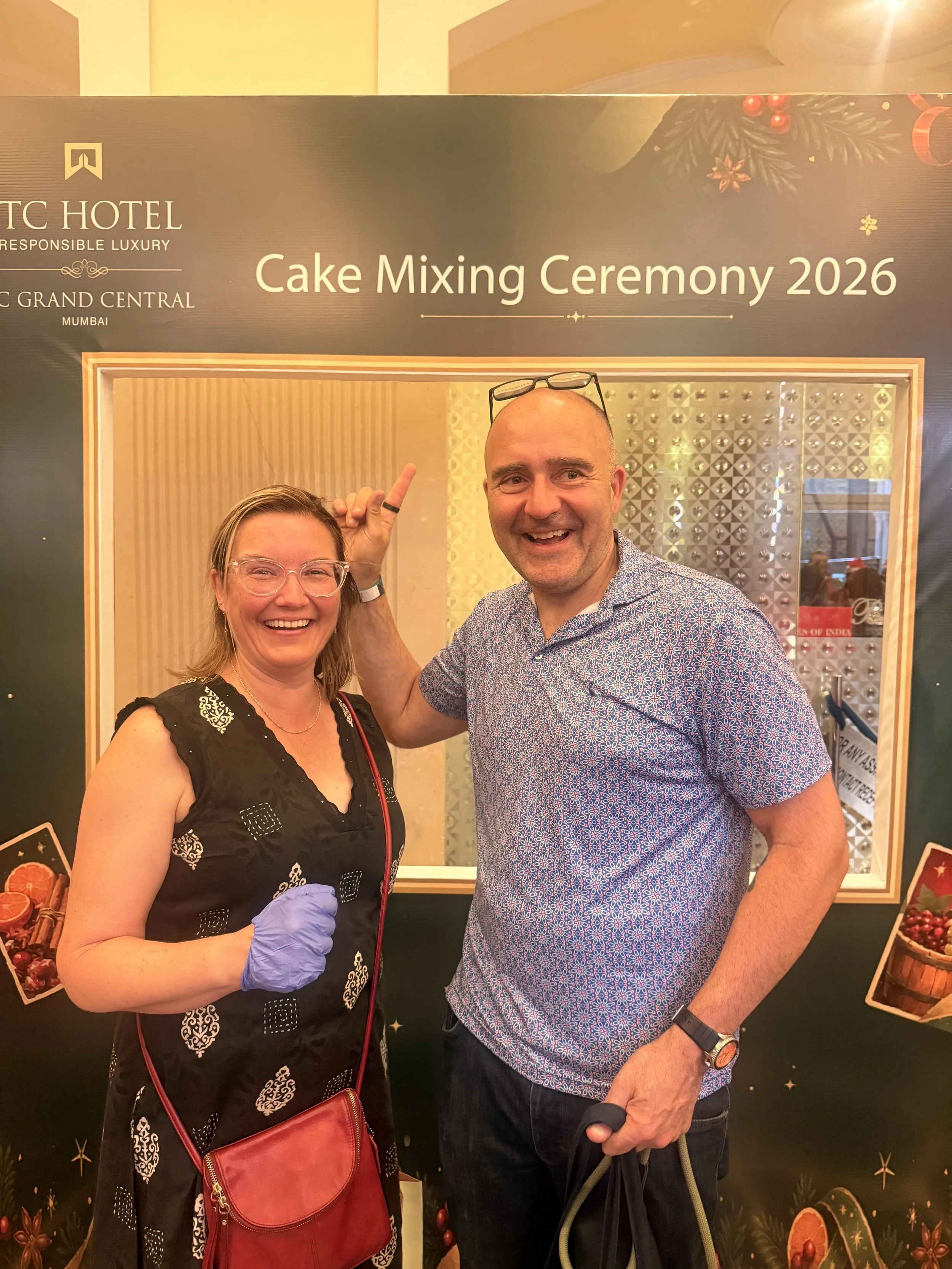
Cake Mixing Ceremony 2026…
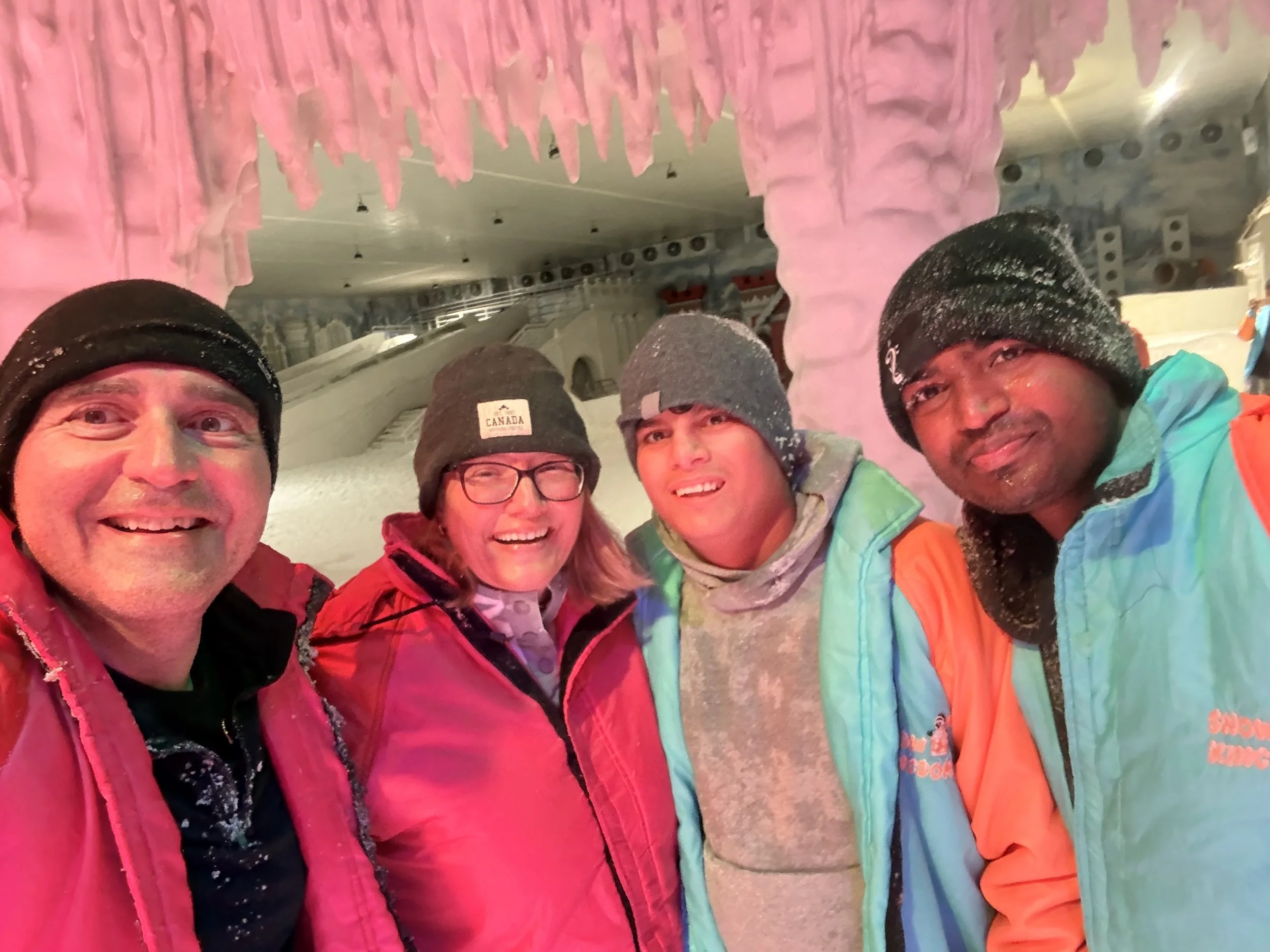
Hydrabadi Winter Wonderland…